- Blog
Revealing Composite I-Beam Damage with Ultrasound at SAMPE 2026

19th August 2026
Will Haworth, Sonatest

At the SAMPE 2026 Conference and Exhibition in Seattle, WA, student engineering teams pushed composite design to the limit in a structural I-beam competition focused on maximizing strength while minimizing weight.
Among the entries was a beam that would ultimately earn 1st place. Before and after destructive load testing, Sonatest had the opportunity to look beneath the surface using the Veo3 PAUT Instrument and WP2 Wheelprobe. The beam was designed and manufactured by Bubba Ubay of California Polytechnic State University, San Luis Obispo (Cal Poly SLO), under the advisement of Dr. Elthary Elghandour.
While the visible fracture after testing told part of the story, the ultrasonic data revealed what was happening beneath the laminate's surface.
Scanning Before the Load Test
Prior to testing, encoded amplitude and depth C-Scans were collected on the flange to establish a baseline condition of the structure.
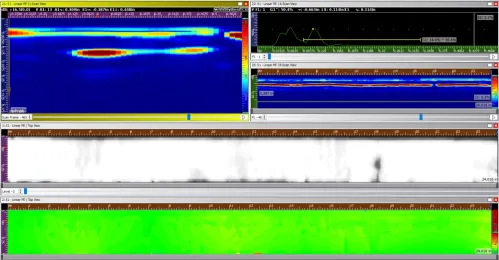
Fig. 1 – Pre-test phased array inspection of the flange collected using the Veo3 and WP2 WheelProbe. The upper left image shows the sectorial/L-Scan view, while the upper right displays the corresponding A-Scan. The B-Scan shows a strong, continuous backwall response throughout the flange, except for one localized indication. The lower images show the encoded amplitude and depth C-Scans used to map backwall continuity and reflection depth across the inspection area.
The scans showed a generally uniform response throughout the flange, confirming strong overall structural consistency. However, one localized indication displayed a partial loss of backwall signal. The indication was consistent with a possible lamination, disbond, or trapped foreign object debris (FOD) within the composite structure.
Interestingly, this indication remained unchanged after destructive testing, suggesting it was a stable manufacturing-related condition rather than an actively growing defect.
Structural Failure After Testing
Following destructive bending tests, visible damage was observed near the edge of the flange where the highest stresses occurred during loading.
Although the beam achieved exceptional structural performance and ultimately earned 1st place in the competition, the post-test phased array data revealed substantial internal laminate damage beneath the visible fracture region.
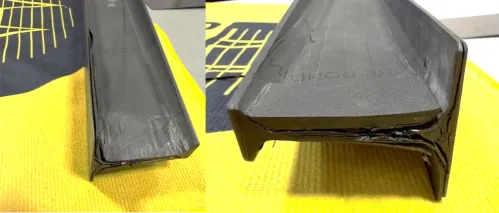
Fig. 2 - Visible damage on the composite flange following destructive load testing
Post-Test Ultrasonic Results
Post-test scans revealed major structural separation on the left side of the flange.
Unlike the pre-test inspection, the sectorial scan now displayed multiple reflections at different depths within the laminate structure. Rather than a single clean backwall response, the ultrasonic data indicated that the flange had internally separated into multiple reflecting layers due to delamination and laminate breakup caused by the extreme bending load.
The encoded C-Scans further highlighted the damaged region through disrupted backwall continuity and varying reflection depths within the separated laminate layers.
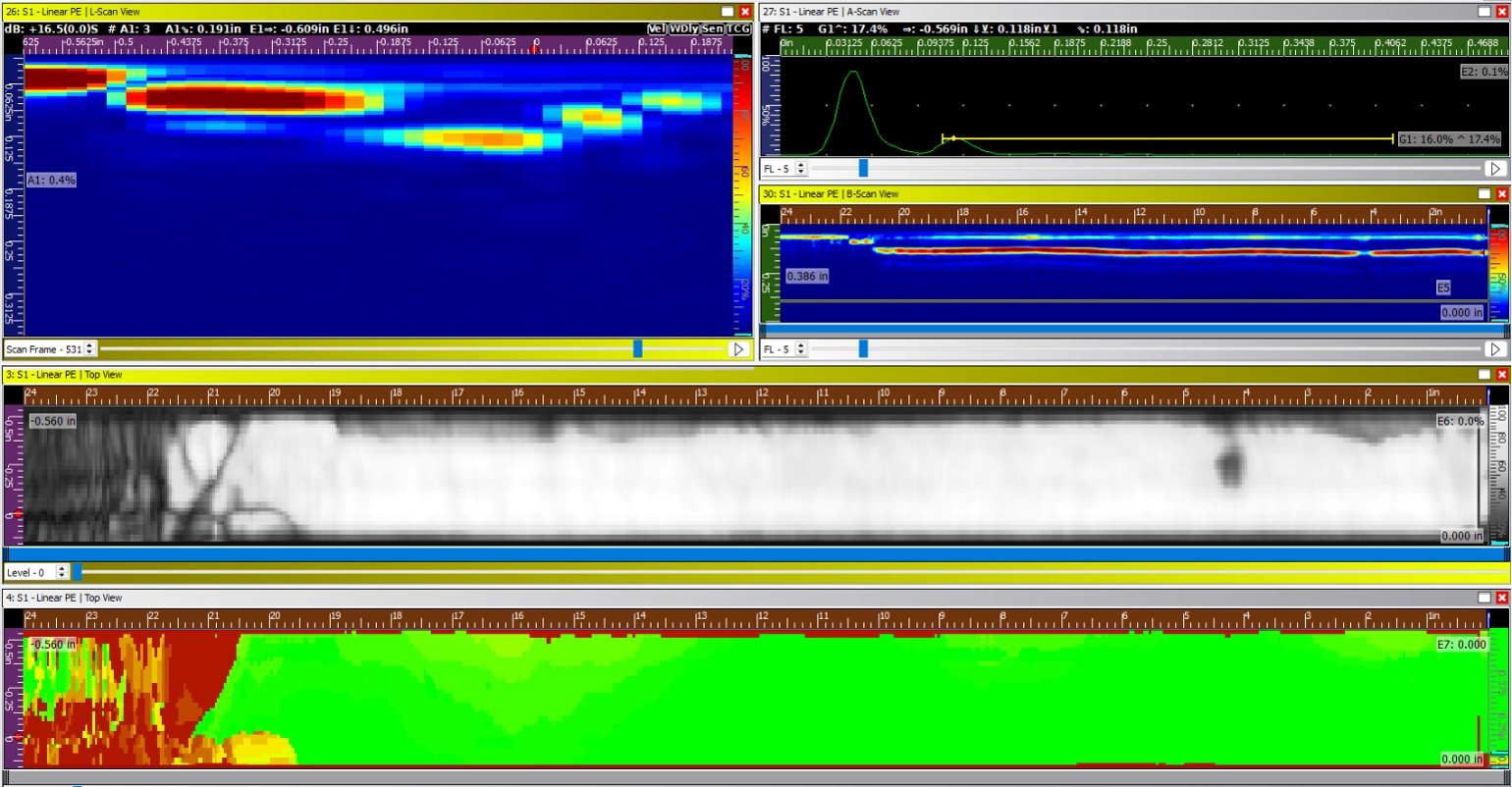
Fig. 3 - Post-test phased array inspection showing significant internal damage on the left side of the flange. The sectorial scan shows multiple reflection depths due to multilayer laminate separation and internal structural breakup after destructive testing.
Why Encoded C-Scans Matter
Composite structures frequently develop internal damage that extends well beyond visible surface indications. Using the Veo3 and WP2 WheelProbe, encoded phased-array inspection provided rapid visualization of:
- Delamination
- Ply separation
- Loss of backwall continuity
- Reflection depth variation
- Internal structural breakup
By comparing pre- and post-test data, it became possible to distinguish stable pre-existing indications from actual load-induced structural damage and to better understand how the composite beam responded under extreme stress.
Conclusion
The SAMPE student beam competition provided an excellent real-world demonstration of phased array ultrasound for composite inspection and failure analysis. Using the Veo3 and WP2, Sonatest documented both stable internal indications and significant post-test laminate damage in the award-winning beam.
While the competition highlighted innovative composite engineering and structural performance, the ultrasonic data revealed the material's hidden internal response, once again demonstrating why advanced ultrasonic imaging remains a powerful tool for evaluating composite structures.
Contact our Sales Team - get expert advice tailored to your requirements.
Discover more Solutions.
News Filter...
The latest news from Sonatest direct to your inbox.
Tags
- Phased Array
- Careers
- Exhibitions
- TFM
- CRFRP
- Composite Materials
- UT Testing
- WheelProbe 2
- Wave
- Software Update
- Transducers
- Education
- Weld Inspection
- Corrosion Mapping
- Ultrasonic Testing
- alphagage+
- Linear Scan
- Pipeline Integrity
- User Story
- Weldments Advanced UT
- metals
- Austentic steels
- Pipelines
- Storage Vessel
- Pressure Vessel
- Rail
- Boiler
- Flanges
- Nozzels


