- Application Notes
Assessing Impact Damage in Composite Fairings
Barely Visible Impact Damage (BVID) in composite fairings, nacelles, and radomes can compromise the structural integrity of non-metallic aircraft components.
Follow our latest UT inspection series
Although often invisible on the surface, internal resin and fiber damage may reduce load-bearing capacity or propagate under fatigue. Accurate detection and mapping of such damage is essential for maintenance decision-making. Phased array ultrasonic testing (PAUT) provides a fast, repeatable, and data-rich method for evaluating BVID, especially when combined with encoded scanning and high-resolution C-scan displays.
Inspection Challenge
Curved carbon fiber reinforced polymer (CFRP) structures pose several challenges:
- BVID is often shallow and low amplitude, making it difficult to detect with traditional A-scan evaluation.
- Curved geometries require consistent wedge coupling and stable probe alignment.
- Damage can vary in depth and shape, including resin cracks, fiber breakage, or delaminations, sometimes stacked or branching.
To evaluate these defects effectively, the inspection solution must provide both spatial coverage and through-thickness information.

Fig. 2 - Left to right: A visible dent in a CFRP panel, sound wave interaction with internal damage using PAUT, resulting B-scan showing signal disruption, and final C-scan mapping damage size and location.
Proposed Solution
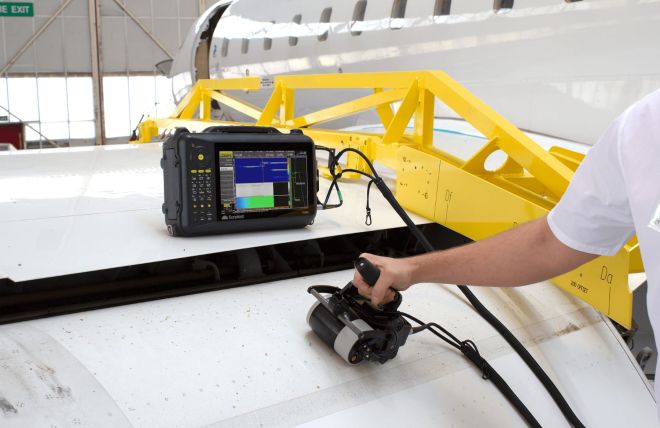
Using the Sonatest Veo3 paired with an X3A linear array and Glider rubber wedge, inspectors can perform encoded linear scans along the fairing or panel surface. The Glider wedge conforms to moderate curvature, maintaining contact without heavy couplant. The AXYS encoder enables precise spatial recording of the scan path, allowing full C-scan reconstruction.
Scans are configured using a linear PAUT beam, capturing reflected signals through the laminate. Multiple scan views, including B-Scans and C-Scans, are generated to assess flaw presence and severity.
Flaw Detection and Evaluation
- Amplitude C-Scan: Displays signal strength across the scanned area. Local amplitude loss is a key indicator of resin crushing or fiber damage
- Depth C-Scan: Uses time-of-flight data to determine the depth of reflectors. This view is critical for locating delamination and assessing stacking through the laminate
- B-Scan (Cross-Sectional View): Visualizes flaw depth profile along the scan path
- A-Scan (Raw Echo): Used to confirm indications, evaluate echo shape, and measure arrival times
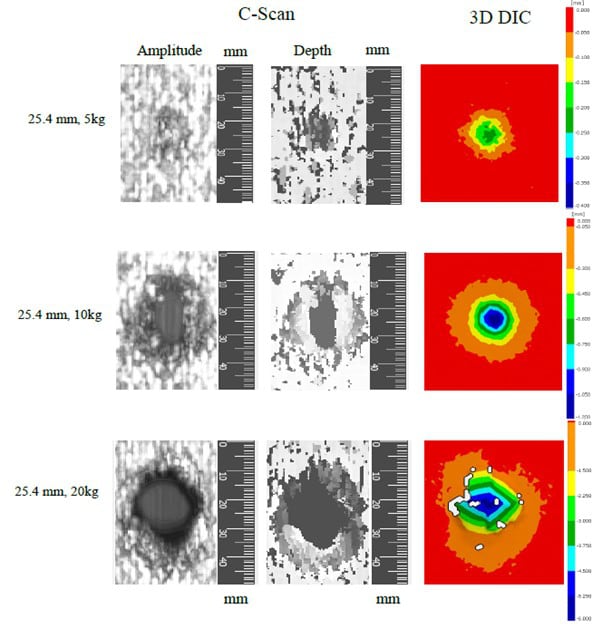
Fig. 3 - C-scans and residual depth of indentation visualisations of specimens impacted with the 25.4 mm impactor
Shallow matrix damage may cause minimal amplitude loss but still appear as surface-breaking in the depth view. Deep delamination often produce a broader low-amplitude zone in the amplitude C-scan and a consistent reflector in the depth C-scan.
Benefits
- High-resolution flaw mapping across the surface and through the thickness
- Rapid scanning with encoded position tracking
- Multiple display modes help distinguish between minor and critical damage
- Ideal for inspecting curved or contoured composite surfaces
- Repeatable results for documentation and comparison over time
Recommended Equipment
- Veo3 phased array ultrasonic flaw detector
- X3A 64-element linear array probe (2.25–10 MHz depending on laminate thickness)
- Glider rubber wedge for contoured surface inspection
- AXYS Encoder for scan tracking and C-scan generation
Conclusion
Impact damage in CFRP is often hidden but structurally significant. PAUT with the Veo3 and X3A Glider setup offers a powerful, technician-friendly solution for inspecting curved composite panels. Amplitude and depth C-scans provide complementary insights, enabling technicians to detect, size, and locate internal flaws with confidence. This approach supports faster, more accurate inspection and enhances maintenance decision-making in aerospace composite MRO environments.
Please contact our Sales Team if you have any questions. You can also find more solutions on our website.
To subscribe to our Aerospace Ultrasonic Inspection Series, please click here.
Filter by Industry
- Aerospace Aeronautical
- Aerospace Astronautical
- Chemical & Petrochemical
- Oil & Gas
- Nuclear Energy
- Wind Power Renewables
- Transport Network Infrastructure
- Rail
- Military
- Maritime Shipping
- Automotive
- Pharmaceutical
- Mining
- Construction & Infrastructure
- Technology & Research
- NDT Service Providers
- NDT Education


