- Application Notes
Reliable PA-TFM Imaging on T-Joints
A T-joint consists of two plates welded at 90° to each other in the form of a 'T'. Commonly used in the structural industry, T-joints generally use fillet or groove-type welds on each side of the vertical plate; these welds can be ‘part’ or ‘full’ penetration welds, each presenting its own challenges.

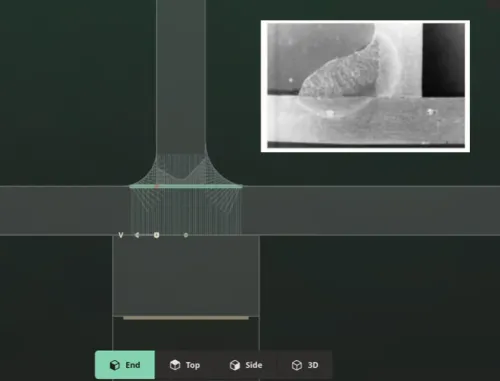
Fig. 1 - XEO scan plan (left) for detection of the unfused land in a T-Joint as highlighted (above)
There is a complexity in setting up a scan over different angles and reflections. The probe to weld location and scan parameters are critical because the resulting interpretation can be misled by geometry echo instead of a true defect.
There are known advantages in PA-TFM imaging because the defect profile fidelity is more accurate than just a single A-Scan for instance. By combining customised overlay drawings, precise ray tracing simulation with a high-resolution PA scan, the setup should lead to a successful investigation.
What Defines an Effective T-Joint Inspection?
The XEO configuration builder ensures that the programmed inspection parameters accurately reflect the physical probe positioning and component geometry, enabling repeatable and auditable inspections.
Reliable assessment demands ongoing awareness of beam paths, including various skip modes caused by different T-joint orientations. Clear separation between geometric responses and genuine defect signals is crucial to prevent misinterpretation and to achieve accurate flaw identification.
Typical Defects in T-joints
The most common defects in T-joint welds are cracks, lack of fusion and lamellar tearing, all of which can be inspected with conventional ultrasonic methods.
Lack of Penetration
In T-joint welds, lack of fusion is directly linked to joint geometry and weld penetration type. In partial penetration welds, an unfused region between the two plates is intentional and must be measured. In full penetration welds, this same region is expected to be fully fused and must be inspected for unintended lack of fusion.
Detection is geometry-dependent: a straight-beam approach on the lower flange provides optimal sensitivity, but access constraints often require alternative inspection configurations.
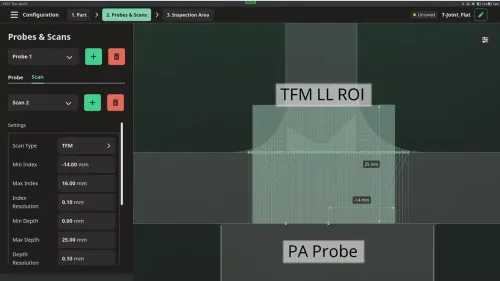
Fig. 2 - Showing the XEO TFM scan plan for the detection of the unfused land in a T-Joint
Lamellar Tearing
Lamellar tearing results from weld contraction acting on low-ductility base material, creating high through-thickness stresses near or outside the HAZ. The tearing typically runs parallel to the weld fusion surface.
T-joints and corner joints are particularly susceptible due to their geometry. Because of its predictable orientation, lamellar tearing is well-suited for detection from the lateral web of the joint.
A clear strategy emerges to solve the last two defect types. A linear scan at 0 degree should pick up this planar like defect. Even better, a TFM with L-mode resolution would provide a clearer profile of the indication.
Cracking
Cracks arise from combined metallurgical and mechanical factors, often caused by residual stresses from thermal expansion and solidification shrinkage. In double-fillet T-joints, the second weld side is more restrained and thus more vulnerable to cracking (see Figure 3).
Crack orientation is unpredictable and may require inspection from multiple angles depending on joint geometry. The XEO answers to these requirements. Its scan plan simulates precise ray tracing and the correct propagation modes that determine an accurate TFM image.
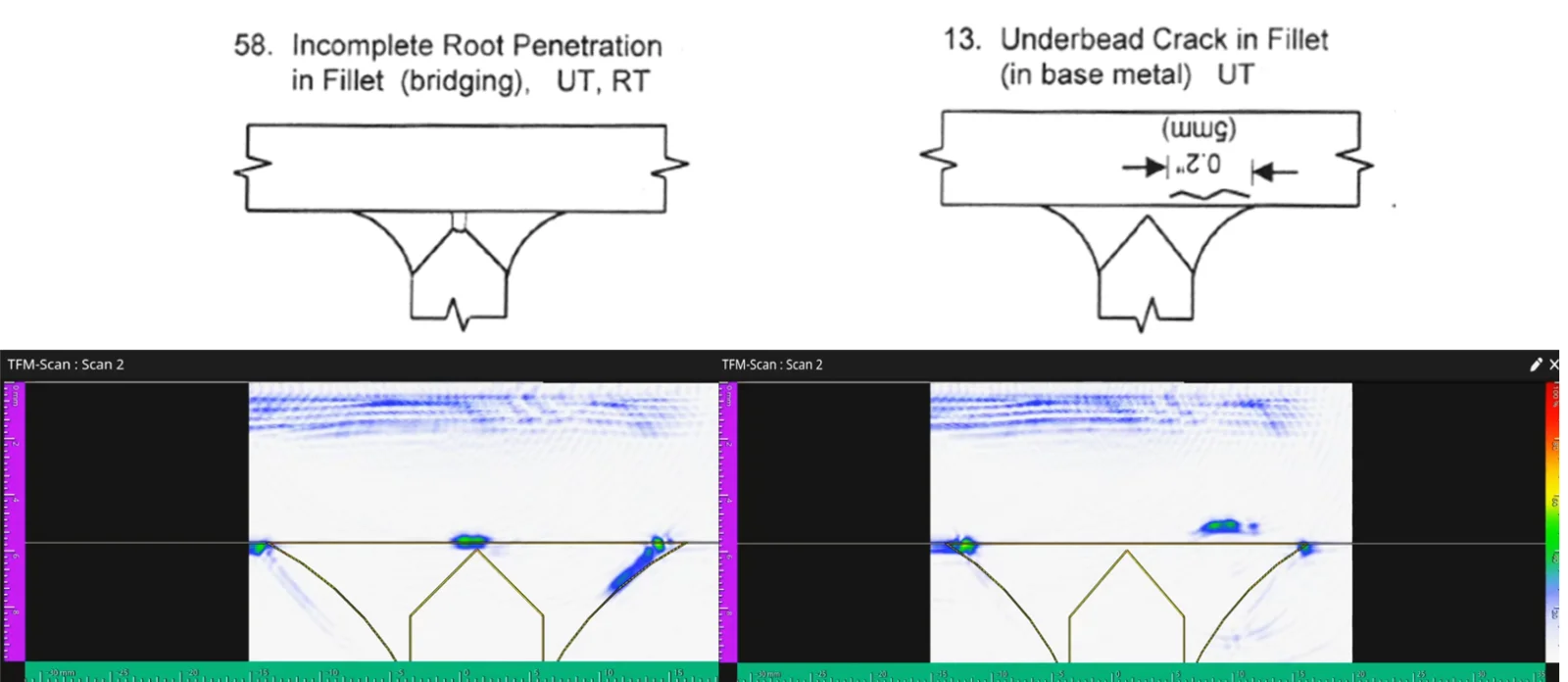
Fig. 3 - Lack of penetration and underbead crack detection, respectively, from LL Imaging
Conclusion
Controlling T-joint welds quickly becomes more complex than inspecting flat welds due to inherent geometric and interpretation challenges. These difficulties can be effectively addressed through accurate part overlays and intuitive optimisation of ultrasonic inspection parameters. The XEO simplifies T-joint assessment by providing the tools needed to manage complex propagation paths and improve defect interpretation with confidence.
Discover our advanced solutions with our experts. Let XEO modernise your inspections.
Please contact our Applications Team if you have any questions. You can also find more solutions on our website.
Stay up to date with our latest content. Sign up here to get our blogs delivered straight to your inbox.
Filter Resources
Filter by Industry
- Aerospace Aeronautical
- Aerospace Astronautical
- Chemical & Petrochemical
- Oil & Gas
- Nuclear Energy
- Wind Power Renewables
- Transport Network Infrastructure
- Rail
- Military
- Maritime Shipping
- Automotive
- Pharmaceutical
- Mining
- Construction & Infrastructure
- Technology & Research
- NDT Service Providers
- NDT Education

