
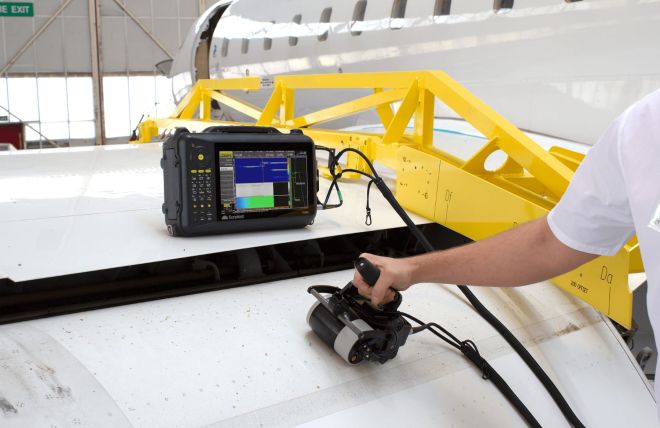
Follow our latest UT inspection series
Ultrasonic inspection is crucial in aerospace manufacturing and maintenance, used to verify materials, detect flaws, and record structural integrity.
While traditional UT remains common, phased array UT (PAUT) has become the preferred method for modern applications, providing notable improvements in both inspection quality and efficiency. Many aerospace manufacturers also work with NDT Service Providers to ensure inspections are carried out efficiently and in accordance with industry standards.
This blog explores how PAUT compares to conventional UT, particularly for inspecting composite panels, bonded structures, and complex assemblies.
What is Conventional Ultrasonic Testing?
Conventional UT uses a single transducer to send and receive sound along a fixed beam path. It’s effective for:
- Thickness measurement
- Basic flaw detection
- Lamination checks in materials
However, conventional UT does not provide imaging and relies heavily on the operator’s interpretation of the A-Scan. Its scan coverage is limited, and flaws can easily be missed, especially in large or layered parts like CFRP or sandwich panels.
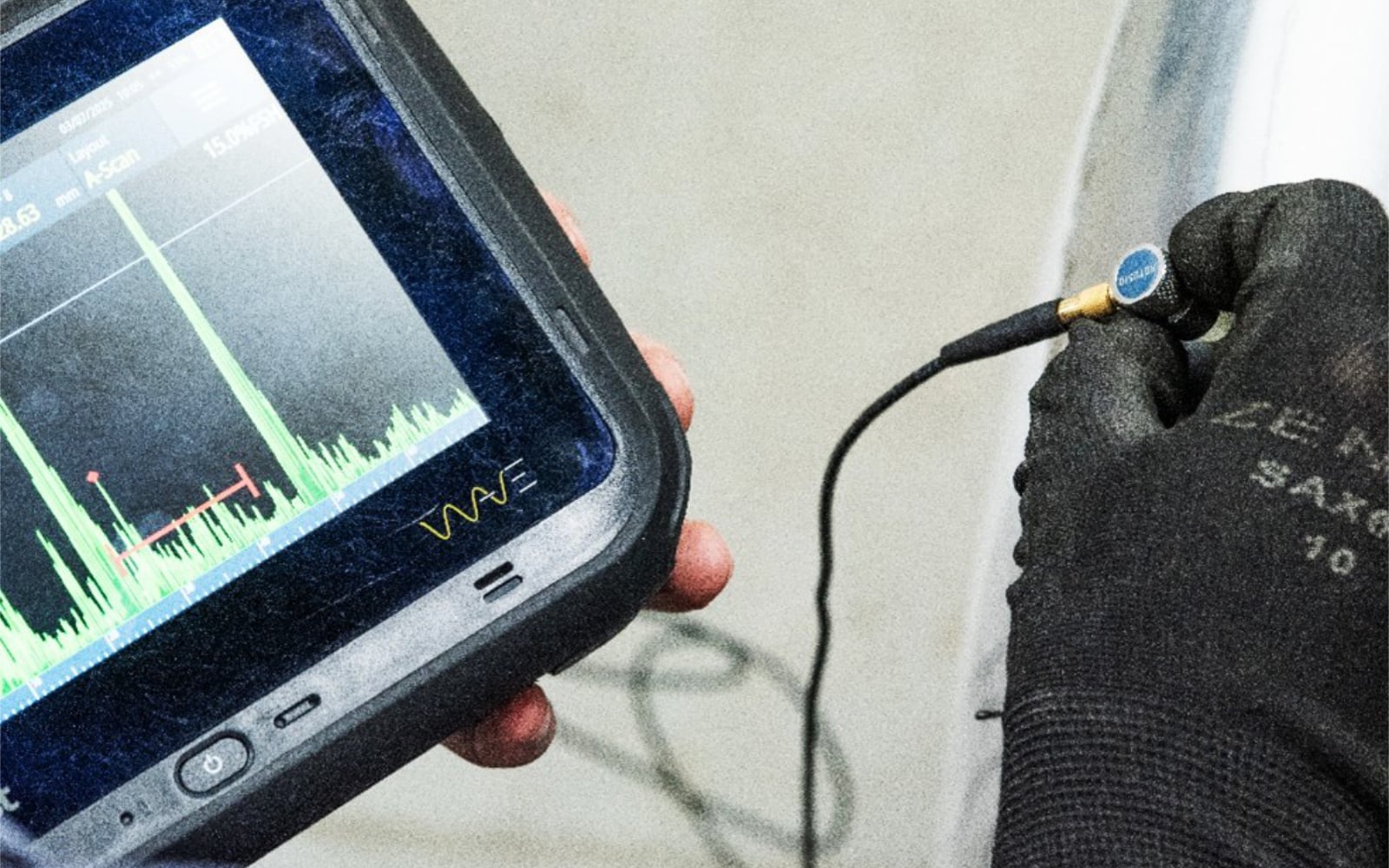
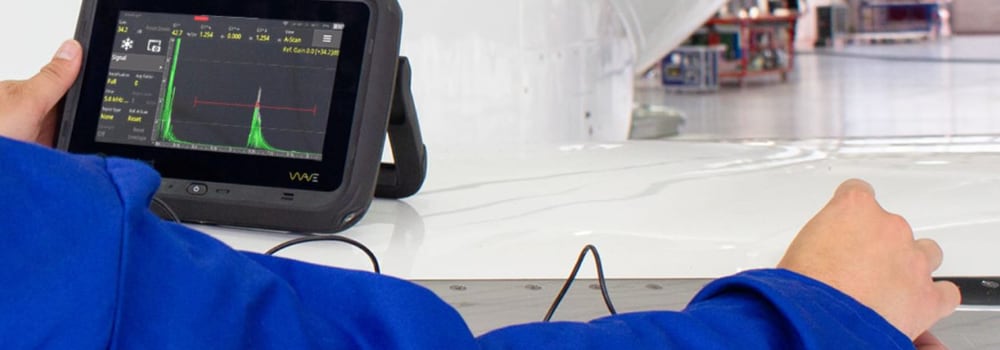
Fig. 1 - Conventional UT thickness measurement on a composite engine inlet. The A-scan indicates a subtle shift in backwall echo due to a localized defect, but without imaging or positional data, detection and evaluation are limited.
What is Phased Array Ultrasonic Testing?
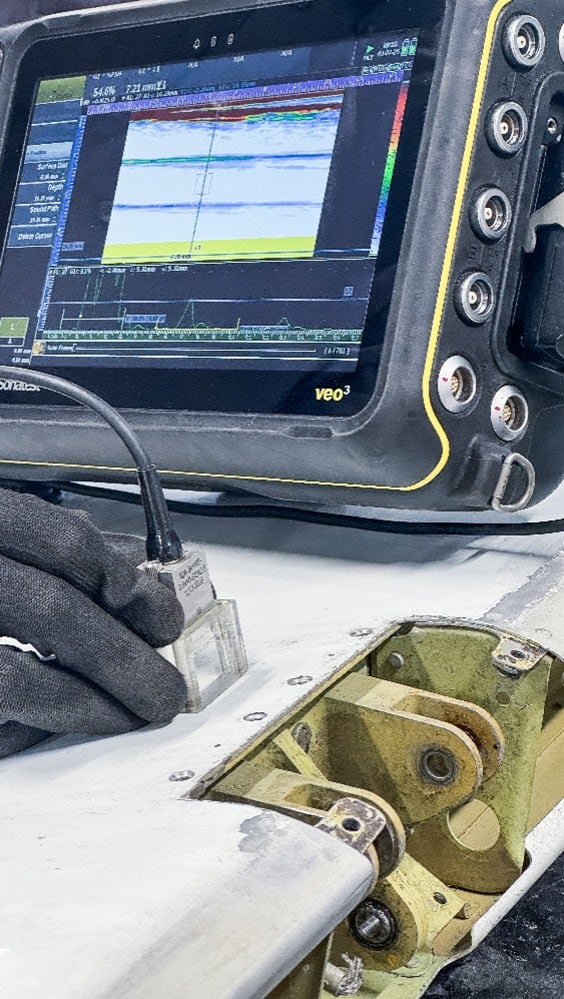
Phased array uses a probe with many small elements that are pulsed sequentially to electronically scan, steer, and focus the beam. In aerospace, PAUT is usually performed in linear scanning mode, which is ideal for inspecting layered composite and bonded structures.
The result? Phased array improves both how much you can inspect at once and how well you can see flaws.
Quality and Quantity: Why Phased Array Excels
Greater Coverage
- Larger probe apertures with many elements scan wider areas in one pass
- Linear scanning reduces the number of physical probe movements
- Excellent for large panels, stiffeners, or bonded joints
Higher Resolution
- Smaller elements and electronic focusing enhance flaw sensitivity
- Detects subtle delaminations, porosity, disbonds, and thickness changes
- Imaging tools like C-Scans and B-Scans make flaws easier to identify, interpret, and document
While a conventional A-Scan might show only a slight drop in amplitude, a C-Scan from a phased array reveals the flaw’s size, shape, and position clearly, especially valuable for flaw mapping and reporting in aerospace environments.
Fig. 2 - Phased array probe scanning a similar panel. Multiple focal laws and encoded data collection provide detailed coverage across a larger area, enabling real-time C-scan and B-scan imaging with improved defect characterization and traceability.
Side-by-side Comparison
| Feature | Conventional UT | Phased Array UT (PAUT) |
|---|---|---|
| Probe Type | Single element | Multi-element array |
| Scan Coverage | Narrow | Wide (linear scanning) |
| Imaging | A-Scan only | C-Scan, B-Scan, real-time views |
| Resolution | Moderate | High (focused beam control) |
| Operator Dependency | High | Reduced with scan planning |
| Best Use | Simple flaw detection or thickness | Large panels, bonds, flaw mapping |
When to Use Each
Conventional UT still has a role:
- Simple spot checks
- Thickness readings
- Small areas
Phased array is the better option when:
- Flaws are subtle or near bond lines
- Coverage needs to be fast and thorough
- Documentation and traceability are required
- Working with composite materials or curved geometry
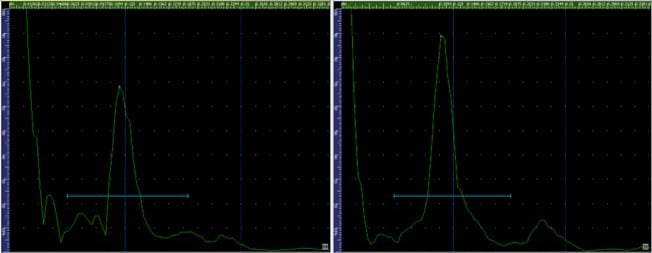
Fig. 3 - A-scan comparison from conventional UT: the left trace shows a clean, defect-free response, while the right reveals a far-side disbond. This highlights the difficulty in detecting near-surface or subtle flaws in real-time A-scan interpretation.
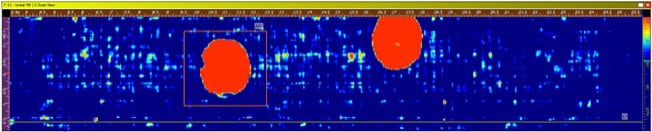
Fig. 4 - Corresponding C-scan of the same inspection area using phased array. The defect is clearly visible, with precise location, size, and depth information, demonstrating the advantage of encoded data capture and imaging.
Conclusion
Phased array improves both the amount of area you can inspect and the clarity of what you detect. In modern aerospace inspection, especially when dealing with composite skins, bonded joints, and large panels, PAUT provides superior speed, sensitivity, and reliability.
Whether you need better flaw detection, faster throughput, or traceable inspection records, phased array delivers both quality and quantity in one solution.
Please contact our Sales Team if you have any questions. You can also find more solutions on our website.
To subscribe to our Aerospace Ultrasonic Inspection Series, please click here.
News Filter...
The latest news from Sonatest direct to your inbox.
Tags
- Phased Array
- Careers
- Exhibitions
- TFM
- CRFRP
- Composite Materials
- UT Testing
- WheelProbe 2
- Wave
- Software Update
- Transducers
- Education
- Weld Inspection
- Corrosion Mapping
- Ultrasonic Testing
- alphagage+
- Linear Scan
- Pipeline Integrity
- User Story
- Weldments Advanced UT
- metals
- Austentic steels
- Pipelines
- Storage Vessel
- Pressure Vessel
- Rail
- Boiler
- Flanges
- Nozzels